
Magnet Experiment for Kids: Fun STEM Activities That Inspire Young Scientists
each other away? To children, it feels like magic—but it’s actually science! A magnet experiment for kids is one of the easiest and most exciting ways to introduce young learners to STEM (Science, Technology, Engineering, and Mathematics). Through simple, hands-on activities, children discover how magnetic forces work while building curiosity, confidence, and problem-solving skills.
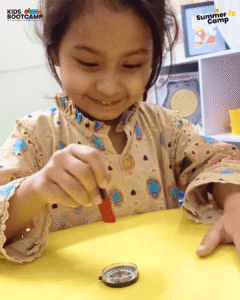
At Kids Bootcamp, we recently organized an engaging STEM session where children explored magnets through exciting experiments, interactive games, and real-world demonstrations. Instead of simply learning scientific facts, they became young scientists—making predictions, testing ideas, and discovering answers through exploration.
Why Magnet Experiments Are Perfect for STEM Learning
A magnet experiment for kids combines fun with education. Magnets are safe, easy to use, and instantly capture children’s attention. More importantly, they introduce important scientific concepts in a way that young learners can understand.
Hands-on STEM activities help children:
– Develop critical thinking skills.
– Improve observation and reasoning.
– Learn through trial and error.
– Build confidence by making discoveries.
– Strengthen communication and teamwork.
– Encourage creativity and curiosity.
Rather than memorizing information, children experience science firsthand—and that makes learning memorable.
What Is a Magnet?
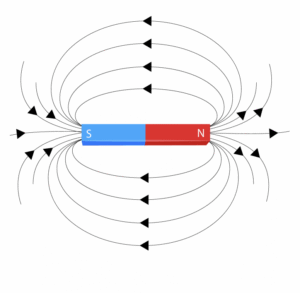
A magnet is an object that attracts certain types of metals, such as iron and steel. Magnets create an invisible magnetic field that allows them to pull or push other magnetic objects without touching them.
Although magnetic force cannot be seen, its effects are easy to observe through simple experiments. This makes magnetism one of the best science topics for children who are just beginning their STEM journey.
Experiment 1: Magnetic vs. Non-Magnetic Objects
Our first magnet experiment for kids challenged children to explore everyday classroom objects.
We placed various materials on a table, including:
– Paper clips
– Keys
– Coins
– Wooden blocks
– Plastic toys
– Bottle caps
– Rubber erasers
– Spoons
– Pencils
Before testing each object, the children predicted whether it would stick to the magnet. Once they tested the objects, they sorted them into two groups.
Magnetic Objects
– Paper clips
– Iron nails
– Steel spoons
– Metal keys
Non-Magnetic Objects
– Plastic toys
– Wooden blocks
– Paper
– Rubber
– Fabric
This activity encouraged observation, prediction, comparison, and logical thinking while introducing children to the basic properties of magnets.
Experiment 2: Attraction and Repulsion
One of the most exciting moments came when children explored how magnets interact with each other.
They discovered that:
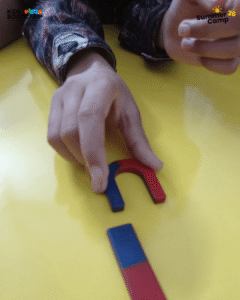
– Opposite poles attract each other.
– Like poles repel each other.
Instead of simply explaining these concepts, we encouraged children to test different sides of two magnets repeatedly. Every successful prediction made the activity even more exciting.
Watching magnets pull together—and then suddenly push apart—was one of the highlights of the session.
Experiment 3: Magnetic Fishing Game
Learning becomes even more meaningful when science is combined with play.
Our magnetic fishing game challenged children to catch colorful paper fish using fishing rods fitted with magnets. Every fish contained a small metal clip, allowing children to experience magnetic force while enjoying a fun challenge.
This activity helped improve:
– Hand-eye coordination
– Concentration
– Patience
– Fine motor skills
– Teamwork
Without realizing it, children were applying scientific concepts through play.
Experiment 4: Levitating Magnet
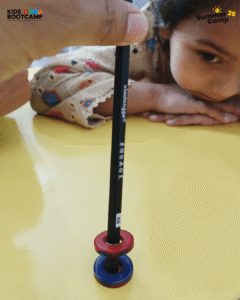
One of the most fascinating moments during our magnet experiment for kids was creating a levitating magnet. To children, it looked like the magnet was floating in mid-air, but they soon discovered that science—not magic—was making it happen.
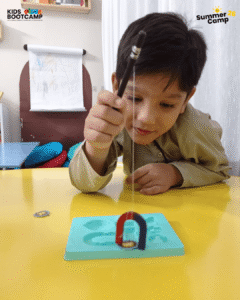
Using a magnetic levitation kit with a guide rod, we stacked ring magnets in the correct direction. As the children carefully placed each magnet onto the rod, they noticed that some magnets pushed away from each other instead of sticking together. This magnetic repulsion created a small gap between the magnets, making one appear to float.
The activity encouraged children to experiment by flipping the magnets and observing how their behavior changed. They quickly learned that when the same magnetic poles face each other, they repel, creating the levitating effect.
Through this exciting STEM activity, children explored important scientific concepts, including:
– Magnetic attraction and repulsio
– Invisible magnetic field
– Cause and effec
– Observation and predictio
– Scientific investigation through
– hands-on learning
The levitating magnet experiment quickly became one of the highlights of the session, inspiring children to ask questions and think like young scientists.
Experiment 5: How a Compass Works
Our final activity connected magnets to something children may have seen but never fully understood—a compass.
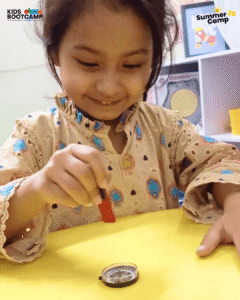
A compass contains a tiny magnetized needle that naturally points toward Earth’s magnetic north.
To make the lesson interactive, we slowly moved another magnet close to the compass. The children observed the needle changing direction and realized that nearby magnets could influence its movement.
This simple experiment introduced the concept of magnetic fields and demonstrated how magnets are used in everyday tools.
Skills Children Developed
Although the session focused on magnets, the learning extended far beyond science.
Children practiced:
– Observation
– Prediction
– Problem-solving
– Communication
– Teamwork
– Fine motor coordination
– Scientific thinking
– Confidence in asking questions
These are valuable life skills that support learning across all subjects.
Why Hands-On STEM Activities Matter
Research has consistently shown that children learn more effectively when they actively participate in the learning process. Reading about science is helpful, but experimenting with it creates deeper understanding.
Hands-on STEM activities encourage children to ask questions, test ideas, make mistakes, and discover solutions independently. This type of learning builds resilience, creativity, and a lifelong interest in science.
A simple magnet experiment for kids can become the first step toward a passion for engineering, technology, or scientific discovery.
Try These Magnet Activities at Home
Learning doesn’t have to stop after the activity ends
Here are a few ideas:
– Search your home for magnetic and non-magnetic objects.
– Create a magnetic treasure hunt.
– Make your own magnetic fishing game.
– Use a refrigerator magnet to test different household items.
– Observe a compass and see how it reacts when another magnet is nearby.
Always supervise children when using small magnets and keep them away from younger siblings who may put them in their mouths.
What Children Learned
By the end of the session, children understood that:
– Magnets attract certain metals.
– Not every object is magnetic.
– Magnets can attract and repel.
– Magnetic force works without direct contact.
– A compass uses magnetism to find direction.
Science becomes more exciting through hands-on exploration.
Most importantly, they discovered that asking questions and experimenting are at the heart of scientific learning.
Final Thoughts
A magnet experiment for kids is much more than a fun classroom activity. It introduces children to the fascinating world of science through exploration, creativity, and discovery. From testing everyday objects to observing attraction, repulsion, floating paper clips, and compass movement, every experiment encouraged curiosity and inspired young minds to think like scientists.
At Kids Bootcamp, we believe the best learning happens when children are free to ask questions, explore ideas, and learn by doing. Our STEM activities are designed to make science enjoyable, practical, and memorable, helping children build the confidence and skills they need for the future.
Whether you’re a parent, teacher, or educator, magnet experiments are a simple yet powerful way to inspire a lifelong love of science.
Frequently Asked Questions
What is a magnet experiment for kids?
A magnet experiment for kids is a hands-on science activity that helps children explore how magnets attract and repel certain objects while learning about magnetic force in a fun and interactive way.
What do children learn from magnet activities?
Children learn about magnetic and non-magnetic materials, attraction and repulsion, magnetic fields, prediction, observation, and problem-solving skills.
Are magnet experiments safe?
Yes. Magnet activities are safe when children are supervised and age-appropriate magnets are used. Small magnets should always be kept away from young children due to choking hazards.
Learn More About Magnet Science
Explore more STEM resources from trusted educational organizations:
- NASA STEM: https://www.nasa.gov/stem
- Science Buddies: https://www.sciencebuddies.org
- National Geographic Kids: https://kids.nationalgeographic.com/science
