Easy Art Activities for Preschoolers: 15 Creative Ideas
Easy Art Activities for Preschoolers: Simple Ideas for Creative Learning
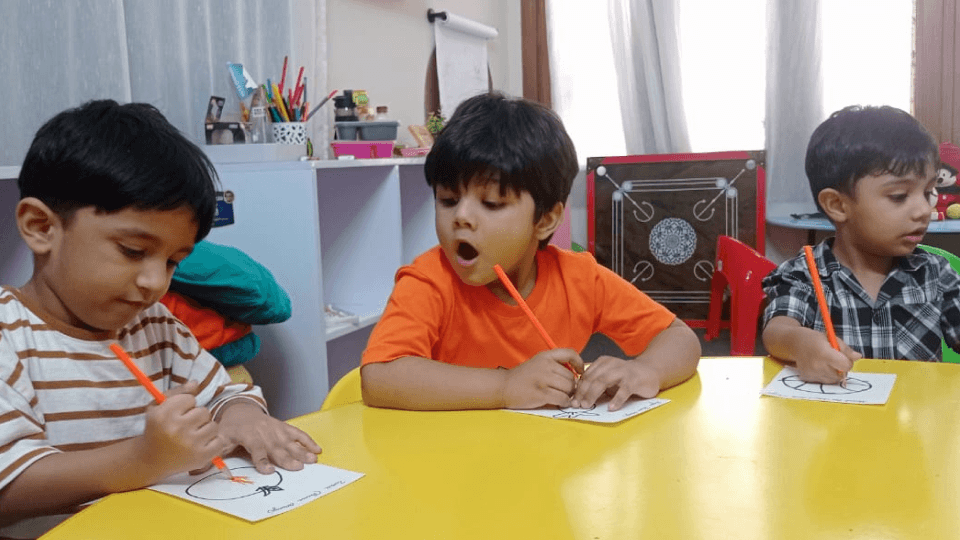
A four-year-old sits at the table with a sheet of paper, three paint colours and a sponge.
You expect a flower.
Instead, there are blue circles, yellow fingerprints, a long green line and something that looks vaguely like a dinosaur.
“It’s a garden,” she explains.
That moment is easy to overlook, but it tells us something important about preschool art activities: the child’s idea matters more than whether the finished picture looks like the example an adult had in mind.
For children ages 3–5, art can be a way to explore colour, texture, movement, shapes and materials while developing fine motor control, language, confidence and problem-solving. Process-focused art in particular gives children room to make choices and experiment instead of simply copying a finished model.
The National Association for the Education of Young Children (NAEYC) recommends process-focused art experiences that give children opportunities to explore materials, make choices and create in their own ways.
The good news for parents is that you do not need an expensive art kit. Some of the best easy art activities for preschoolers can be made with paper, crayons, washable paint, recycled cardboard, leaves, glue and objects already around the house.
What Are Easy Art Activities for Preschoolers?
Easy art activities for preschoolers are simple, age-appropriate creative experiences that allow children to draw, paint, print, cut, tear, stick, mould or experiment with different materials without requiring complicated instructions.
For ages 3–5, the activity should be manageable enough for a young child to participate independently while still leaving room for imagination.
A useful rule is:
Give children materials and an invitation to create, rather than giving them a picture they must reproduce.
This is closely connected to process art, where the focus is on exploration and the child’s choices rather than producing an identical finished craft. NAEYC describes process-focused art as open-ended, child-directed and centred on experimenting with materials, tools and techniques.
That doesn’t mean structured crafts have no value. Cutting, gluing, following a few instructions and completing a simple project can also be useful. The key is to give children opportunities for both guided and open-ended creativity.
Why Is Art Important for Preschoolers?
Art gives young children a different way to think and communicate.
A child who cannot yet explain exactly how she feels may draw a storm. Another child may turn a cardboard box into a rocket. A third may spend ten minutes mixing blue and yellow paint simply to discover what happens.
These experiences can support several areas of development at the same time.
Fine motor development
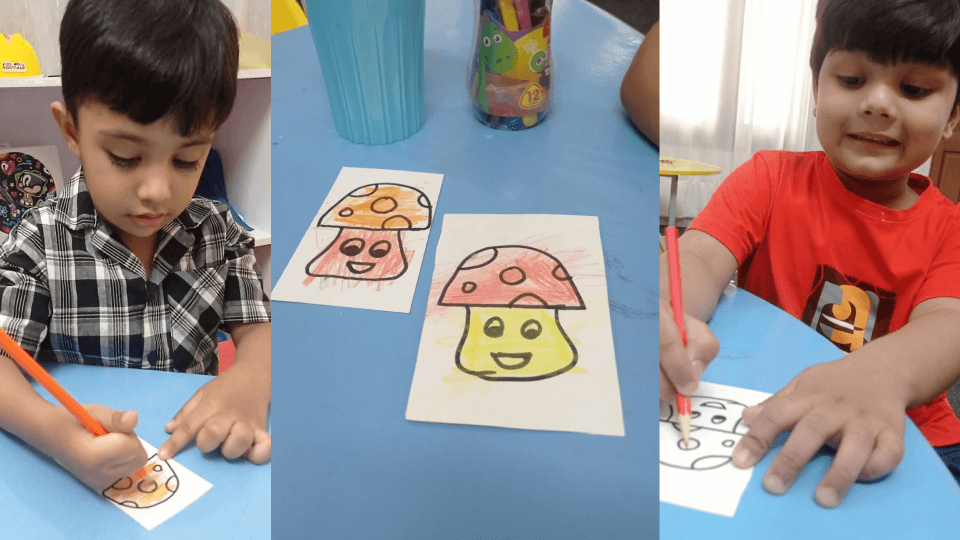
Holding crayons, squeezing glue, using a paintbrush, tearing paper, manipulating clay and making small marks all give children opportunities to practise controlled hand movements.
These are useful foundations for later activities such as drawing, writing, fastening clothing and using classroom tools.
Creativity and problem-solving
Open-ended art gives children decisions to make:
- Which colour should I use?
- What happens if I mix these colours?
- How can I make this shape?
- What can I build from this cardboard?
- What should I add next?
The child is not simply following instructions. They are making choices.
Young children’s learning and development are strongly influenced by the experiences and interactions they have in their everyday environments.
Language development
Art can also become a conversation.
Instead of asking only, “What did you draw?”, try:
“Tell me about your picture.”
That small change gives the child an opportunity to describe ideas, materials, colours, characters and experiences. NAEYC notes that process art can support children’s expressive language as they talk about their creations and choices.
Confidence and self-expression
There is no single correct answer when a child is making an abstract painting.
That freedom can be valuable. Children can try something, change it, start again and discover that their ideas are worth sharing.
15 Easy Art Activities for Preschoolers Ages 3–5
You don’t need to try all of these in one week. Pick one activity, prepare a small workspace and let your child explore.
1. Sponge Printing
Cut a clean kitchen sponge into simple shapes such as circles, squares or triangles.
Place a small amount of washable paint on a plate. Let your child dip the sponge into the paint and press it onto paper.
Soon the page becomes a collection of dots, shapes and patterns.
Try asking:
“What happens when you put two shapes together?”
Learning opportunities: shape recognition, colour exploration, hand control and pattern-making.
2. Leaf Printing
Take a short walk and collect a few fallen leaves.
Place paint on the textured side of a leaf, press it onto paper and lift it carefully.
Children can compare the marks made by different leaves.
In Multan and other parts of Pakistan, this can be an especially nice way to connect indoor creative work with the natural environment around children.
Try asking:
“Which leaf made the biggest print?”
Learning opportunities: observation, texture, comparison and nature exploration.
3. Finger Painting
Put two or three washable, child-safe paint colours on a large sheet of paper.
Let your child use fingers, fingertips or the whole hand to make lines, dots, swirls and patterns.
You don’t need to tell them what to paint.
The interesting part may be watching what happens when colours meet.
Try asking:
“What happened when these two colours touched?”
Learning opportunities: sensory exploration, colour mixing and self-expression.
4. Cotton Bud Dot Painting
Give your child cotton buds and small amounts of washable paint.
They can create dots to make flowers, rain, balloons, animals or completely abstract patterns.
For younger preschoolers, keep the design open-ended rather than expecting a specific picture.
Try asking:
“Can you make a pattern with your dots?”
Learning opportunities: hand control, visual patterns and concentration.
5. Torn Paper Collage
You don’t always need scissors for a collage.
Give children pieces of coloured paper and let them tear them into large and small pieces. They can arrange and glue the pieces onto another sheet.
The final result might become a tree, a house, a rainbow or something entirely unexpected.
Try asking:
“Which pieces would you like to put next to each other?”
Learning opportunities: fine motor control, composition, colour and decision-making.
6. Recycled Cardboard Creations
Before throwing away a small cardboard box, tube or food carton, ask whether it could become something else.
A box can become a house.
A cardboard tube can become a telescope.
Several pieces can become a robot, vehicle or imaginary machine.
Provide paint, glue, paper and child-safe decorative materials and let the child decide what the object will become.
This type of activity can also introduce an early STEAM mindset: design, build, test, change and try again.
7. Nature Collage
Collect safe natural materials such as fallen leaves, petals and small twigs.
Arrange them on paper and glue them down with adult supervision.
Children can create a landscape, animal, pattern or completely abstract design.
Try asking:
“Which natural material feels rough? Which one feels smooth?”
Learning opportunities: sensory awareness, observation, vocabulary and creativity.
8. Marble Rolling Art
Place a sheet of paper inside a shallow box or tray.
Dip a marble into washable paint, place it in the tray and slowly tilt the tray so the marble rolls across the paper.
The child gets to watch movement create lines.
Try asking:
“What do you think will happen if you tilt the tray this way?”
Learning opportunities: cause and effect, movement, prediction and visual exploration.
For safety, this should be a supervised activity because marbles are small objects.
9. Shape Monster Collage
Cut large circles, squares and triangles from coloured paper.
Let children combine the shapes to create funny monsters.
One child may make a monster with triangle ears. Another may create one with six eyes.
Add crayons or markers for details.
Try asking:
“How many shapes did your monster use?”
Learning opportunities: shapes, counting, vocabulary, creativity and fine motor skills.
10. Painting With Household Objects
Paintbrushes are not the only tools children can use.
Try clean objects such as:
- Sponges
- Cardboard tubes
- Bottle bottoms
- Large leaves
- Toy wheels
- Forks, with supervision
- Bubble wrap
Dip an object into paint and see what kind of mark it makes.
This is particularly useful when you want simple art activities for preschoolers that do not require specialist supplies.
11. Crayon Texture Rubbing
Place paper over a textured surface such as a leaf or another safe textured object.
Use the side of a crayon and gently rub across the paper.
The hidden texture begins to appear.
Children often find the reveal surprisingly exciting.
Try asking:
“What do you think is underneath the paper?”
Learning opportunities: observation, texture, pressure control and prediction.
12. Colour Mixing Experiment
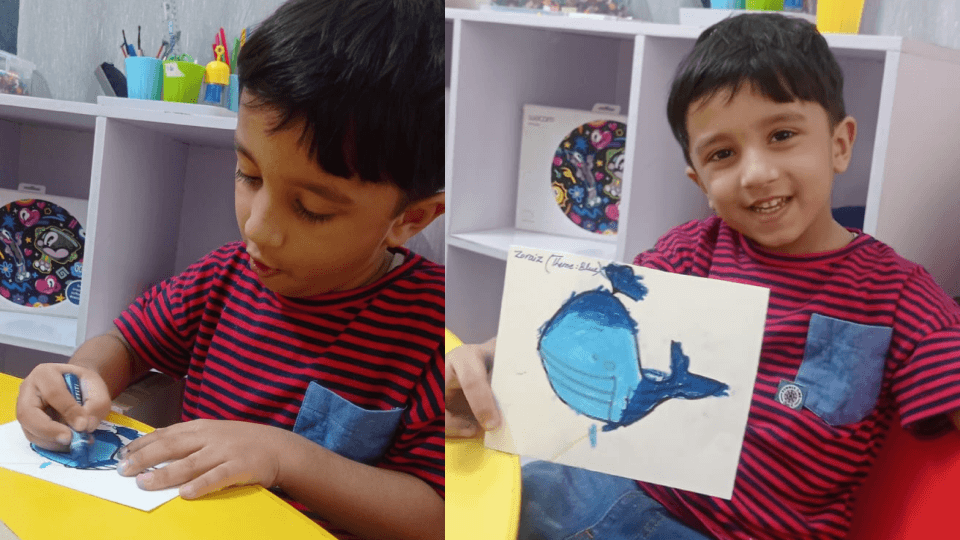
Give your child two paint colours at a time.
For example:
- Blue + yellow
- Red + yellow
- Blue + white
Ask them to mix the colours and observe what changes.
This turns an art activity into a tiny science investigation.
Instead of telling them the answer first, let them discover it.
Try asking:
“What colour do you think we will make?”
Learning opportunities: colour recognition, prediction, observation and early scientific thinking.
13. Play Dough Sculpting
Homemade or child-safe play dough can become an art material.
Invite your child to roll, pinch, flatten, twist and combine the dough.
They might create food for a pretend restaurant, animals, flowers or imaginary characters.
There doesn’t have to be a finished model.
Sometimes the most useful part is simply manipulating the material.
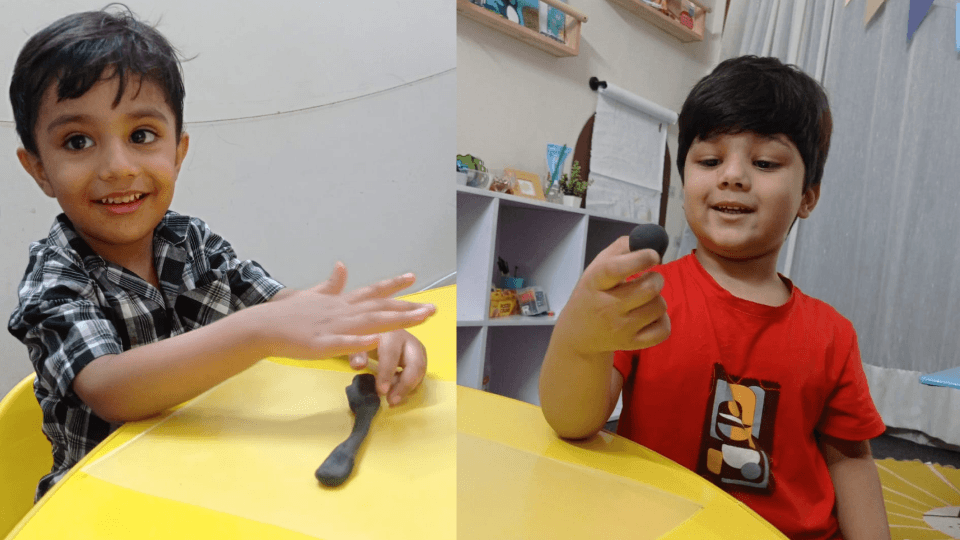
Learning opportunities: hand strength, fine motor control, imagination and sensory exploration.
14. Paint to Music
Put on a piece of music and give your child paper and washable paint.
Rather than asking them to paint an object, invite them to respond to the music using lines, dots, swirls and colours.
Fast music might inspire quick marks. Slow music may encourage longer, slower strokes.
There is no correct painting.
Try asking:
“What kind of line does this music make you want to draw?”
Learning opportunities: listening, movement, emotional expression and creative interpretation.
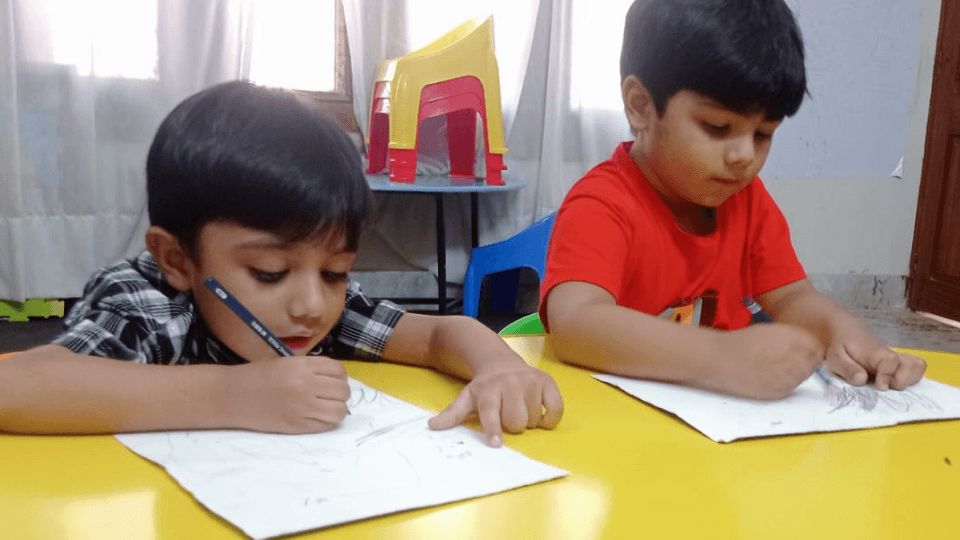
15. Big Collaborative Mural
Tape a large sheet of paper to the floor or a suitable wall.
Let two or more children draw or paint on the same piece of paper.
They can add roads, trees, houses, animals, people, planets or anything else they imagine.
This is one of the more social creative activities for kids ages 3–5 because children have to share space and notice each other’s ideas.
Try asking:
“What can we add to our picture together?”
Learning opportunities: cooperation, communication, creativity and spatial awareness.
A four-year-old can spend twenty minutes carefully building a tower from blocks, another ten minutes pretending the floor is lava, and then suddenly refuse to sit through a five-minute worksheet.For many parents, this can be confusing. Is my child learning enough? Should preschool involve more writing? Why does my child learn so much when they're playing but lose interest when asked to sit still?The answer often comes down to how young children learn.Good preschool activities aren't simply ways to keep children busy. When thoughtfully planned, they give children opportunities to move, experiment, communicate, create, solve problems and make sense of the world around them.That is particularly important when families are choosing a preschool in Multan, where parents may be looking for an environment that balances early academics with confidence, social development, creativity and practical skills.
Which Art Activities Are Best for Children Ages 3–5?
There isn’t one activity that is best for every preschooler.
A three-year-old may enjoy squeezing paint onto paper and exploring texture, while a five-year-old may be ready to plan a collage or build a recycled-material sculpture.
A simple age guide can help:
| Age | Good starting activities |
|---|---|
| Around 3 | Finger painting, sponge printing, large crayons, simple collage |
| Around 4 | Painting, stamping, tearing and gluing, play dough, nature collage |
| Around 5 | Mixed-media art, printmaking, recycled construction, collaborative projects |
These are starting points, not strict developmental rules. Children develop at different rates, so the right activity is one that is safe, manageable and interesting for the individual child.
Should Preschool Art Be About the Finished Product?
Not always.
If every child is expected to produce the same paper flower, there is limited room for individual decision-making. Process-focused art takes a different approach: the adult prepares suitable materials and creates the conditions for exploration, while the child decides what to do with them.
That doesn’t mean parents should never do crafts with a specific outcome.
A guided activity can teach children to follow directions, sequence steps and practise particular skills.
The better approach is to give children both experiences.
Some days can be:
“Let’s make a paper butterfly.”
Other days can simply be:
“Here are some paper, leaves, glue and crayons. What can you make?”
That balance gives children structure without taking away their creativity.
How Can Parents Make Art Time Easier at Home?
The biggest challenge is often not the activity itself. It’s the preparation and the mess.
A few simple habits can make creative time much easier.
Keep an “art box”
You can collect:
- Scrap paper
- Cardboard
- Old magazines
- Paper tubes
- Crayons
- Washable markers
- Child-safe glue
- Sponges
- Leaves and other safe natural materials
- Washable paint
You don’t need to buy everything at once.
Protect the workspace
Use an old tablecloth, newspaper or washable mat underneath the activity.
For paint-heavy activities, an outdoor area or easy-to-clean surface can make cleanup less stressful, particularly during warmer months in Pakistan.
Offer fewer choices
Sixteen colours and twenty materials can be overwhelming.
Start with two or three colours and a small selection of tools.
You can introduce more materials once the child begins exploring confidently.
Don’t fix the artwork
If your child says the purple sun is a sun, it is a sun.
You don’t need to correct it.
Ask about the idea instead.
“Tell me about your purple sun.”
That conversation is often more valuable than making the picture look realistic.
How Can Art Become a Learning Activity Without Feeling Like a Lesson?
The easiest way is to add questions rather than worksheets.
During sponge printing, talk about shapes.
During colour mixing, make predictions.
During collage, count pieces.
During clay work, describe texture.
During painting, talk about movement.
For example, a simple leaf-printing activity can involve art, science and language at the same time:
Art: making a print
Science: observing texture
Math: comparing sizes
Language: describing the leaf
Motor development: pressing and lifting the leaf
This is one reason hands-on creative experiences fit naturally into a child-centred, STEAM-oriented early learning environment.
The activity doesn’t have to be labelled a “lesson” for meaningful learning to happen.
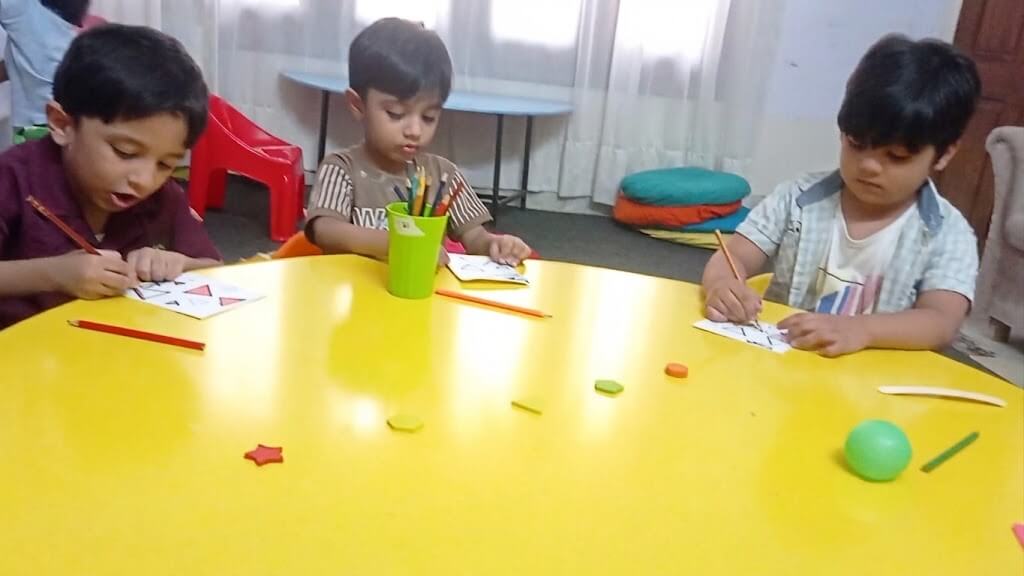
What Should Parents Look for in Preschool Art Activities?
When choosing preschool craft activities, look beyond the photograph of the finished product.
Ask:
- Can my child participate independently?
- Are the materials appropriate and safe for their age?
- Does the activity allow some choice?
- Can my child experiment rather than simply copy?
- Does it involve hands-on interaction?
- Is there room for conversation?
- Can the activity be adapted for different abilities?
- Will my child enjoy the process?
A beautiful craft made mostly by an adult may look impressive, but it tells you little about what the child actually explored.
A page covered in a child’s uneven lines may look simple. Educationally, it can represent much more: choices, movement, experimentation and expression.
Common Mistakes to Avoid During Preschool Art
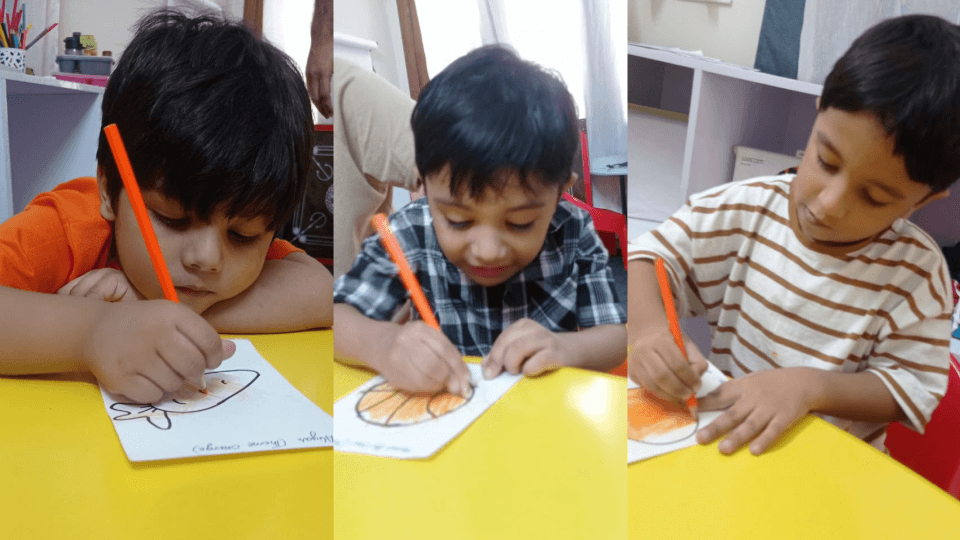
Doing the project for the child
It can be tempting to “help” until the artwork looks perfect.
Try stepping back instead.
Giving too many instructions
A long sequence of instructions can turn creative play into a test of memory.
Keep directions short and demonstrate only when necessary.
Expecting children to stay clean
Art is often sensory.
Use washable materials and protect the workspace rather than making children afraid of getting paint on their hands.
Comparing artwork
“Look how nicely your friend did it” can make children focus on comparison rather than exploration.
Talk about what you notice instead:
“I see you used lots of circles.”
Asking, “What is it?”
Sometimes the child doesn’t know yet.
Try:
“Tell me about what you’re making.”
That leaves room for the idea to develop.

Easy Art Activities in a Pakistani Preschool Setting
Art doesn’t need to be disconnected from children’s surroundings.
A preschool in Multan can use leaves collected from the school garden, recycled packaging, local flowers, seasonal colours, cardboard boxes and everyday household objects as creative materials.
A classroom might explore:
- Leaf printing after a nature walk
- Mango-inspired colour mixing during mango season
- Recycled cardboard construction
- Clay modelling
- Pattern-making with traditional shapes
- Nature collages
- Large collaborative paintings
- Texture exploration using safe everyday materials
The important part is not making an activity look “local” for the sake of it. It is giving children opportunities to connect what they see in their everyday environment with what they create.
For families looking for kids activities in Multan, this kind of hands-on art can also be a simple alternative to activities that depend heavily on screens.
How Art Fits Into Child-Centred Early Learning
At Kids Bootcamp & Preschool, creative work can sit alongside movement, storytelling, science, mathematics and practical exploration rather than being treated as an isolated “craft period.”
Quality early childhood education supports children’s development across multiple areas rather than treating learning as a collection of isolated skills.
That approach matters because children do not naturally separate their curiosity into school subjects.
A child painting a tree may start talking about leaves.
That may lead to counting leaves.
Counting may lead to comparing sizes.
Then the child may wonder why some leaves are green and others are yellow.
One simple art activity can open the door to several kinds of learning.
Play-based experiences give young children opportunities to explore, interact, experiment and learn through active participation.
This is the strength of meaningful creative activities for kids ages 3–5: they can begin with something as simple as a paintbrush and end with a question.
A Simple Takeaway for Parents
You don’t need a Pinterest-perfect setup to encourage creativity.
Start with paper.
Add crayons, washable paint, glue, recycled cardboard or something from nature.
Then give your child time.
Instead of asking, “What are you supposed to make?”, try asking, “What would you like to try?”
That small change gives children ownership of the experience.
And sometimes, the best preschool artwork is not the picture you can immediately recognise. It is the messy page that makes a child stop, look at it proudly and say:
“Look what I made!”
That is where creativity begins.
FAQs
What are some easy art activities for preschoolers?
Some easy options include sponge printing, finger painting, leaf printing, torn-paper collage, nature collage, play dough sculpting, cardboard construction, crayon rubbing and simple colour-mixing activities. Choose materials that are safe and manageable for the child’s age, and allow room for experimentation.
What are some easy art activities for preschoolers?
Three-year-olds can usually begin with simple, hands-on activities such as large-crayon drawing, finger painting, sponge stamping, tearing paper, basic collage and play dough. Keep instructions short and focus more on exploration than producing a particular finished picture.
What creative activities can 4- and 5-year-olds do?
Children ages 4–5 can explore painting, printmaking, mixed-media collage, nature art, recycled-material construction, clay or play dough, collaborative murals and simple colour experiments. Activities can gradually include more planning and decision-making as children become comfortable with the materials.
Does preschool art help fine motor skills?
Many art experiences involve movements such as gripping crayons, squeezing glue, using brushes, tearing paper, manipulating clay and placing small pieces. These activities provide opportunities to practise hand and finger control while children are engaged in a meaningful task.
Should preschoolers copy an example when doing art?
They can sometimes follow a model, especially when learning a particular technique. However, children also benefit from open-ended process art where they can choose materials, colours and methods. NAEYC recommends process-focused experiences that give children time and space to explore and create their own work.
How can I do preschool art activities at home without making a big mess?
Use washable materials, cover the working surface with an old cloth or newspaper, limit the number of materials available at one time and keep cleanup supplies nearby. Outdoor art can also be useful for activities involving larger amounts of paint or water.
What materials do I need for simple preschool art activities?
A basic home art box can include paper, crayons, washable markers, child-safe glue, washable paint, sponges, cardboard, paper scraps and play dough. You can also add safe recycled materials and natural objects such as fallen leaves.
How long should an art activity last for a preschooler?
There is no single ideal duration. Follow the child’s interest and attention. A simple activity may last only a few minutes, while a child who is deeply engaged may continue much longer. It is usually better to stop while the experience is still enjoyable than to force a child to finish.
