
25 Fun 3 Year Old Activities for Playful Learning
25 Fun 3 Year Old Activities for Playful Learning
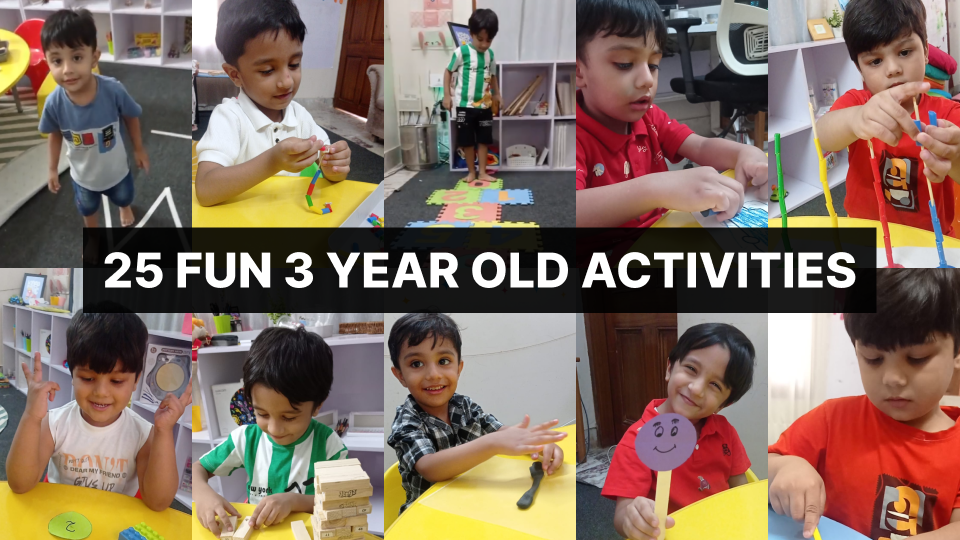
Fun 3 Year Old Activities That Make Learning Feel Like Play
A three-year-old can turn an ordinary cardboard box into a car, a blanket into a tent and a handful of bottle caps into a pretend shop.
That is one of the wonderful things about this age. Children do not need expensive toys or complicated lesson plans to learn. Give them something interesting to explore, enough time to experiment, and an adult who is willing to join in—and a simple activity can become a surprisingly rich learning experience.
If you’re a parent wondering what to do with your three-year-old after preschool, during a quiet afternoon, or when the usual toys have lost their appeal, try activities that involve movement, imagination, conversation, building, creating and exploring.
Play is not separate from learning at this age. It is one of the main ways young children explore their environment, understand cause and effect, practise skills and connect with the people around them. UNICEF and Harvard’s Center on the Developing Child both highlight play and playful interactions as important parts of early learning and development.
Here are some simple fun 3 year old activities that parents can try at home and teachers can adapt for preschool settings.
Why are activities important for a 3-year-old?
At three, children are developing across several areas at once. They are learning to communicate more clearly, coordinate their bodies, solve small problems, express feelings, follow simple instructions and interact with other children.
A good activity doesn’t have to teach a letter, number or worksheet skill to be valuable. Building a tower can involve planning. Pretend cooking can develop language. Dancing can support coordination. Sorting objects can introduce early mathematical thinking.
The goal is not to turn every play session into a lesson. The goal is to give children opportunities to think, move, communicate and discover.
Harvard’s Center on the Developing Child notes that playful activities can help children practise executive-function skills such as focusing attention, remembering information and developing self-control.
25 Fun 3 Year Old Activities to Try at Home or Preschool
1. Cardboard Box Pretend Play
Put a large cardboard box on the floor and ask your child what it could become.
Today it might be a bus. Tomorrow it could be a house, shop or rocket.
You don’t need to provide all the answers. Let your child decide.
What it encourages: imagination, language, problem-solving and social play.
2. Colour Hunt Around the House
Choose one colour and go looking for objects that match it.
“Can you find something red?”
Let your child walk around the room and collect safe objects. Later, change the colour.
For older preschoolers, you can turn it into a sorting game by putting different colours into separate groups.
What it encourages: colour recognition, observation, vocabulary and categorisation.
3. Homemade Playdough Fun
Give your child playdough and a few simple tools such as a rolling pin, cookie cutters or plastic utensils.
Instead of telling them exactly what to make, try prompts such as:
“Can you make something for our pretend restaurant?”
Or:
“What kind of animal could we make?”
The open-ended approach leaves room for creativity.
What it encourages: fine-motor control, imagination and creative expression.
4. Build a Block Tower
Give your child blocks, large construction pieces or other age-appropriate stacking materials.
Build a tower together. Then experiment.
“What happens if we put the big block at the bottom?”
“What happens if we make it taller?”
Your child is beginning to explore balance, size, position and cause and effect without needing a formal science lesson.
What it encourages: spatial awareness, coordination, early engineering thinking and problem-solving.
5. Freeze Dance
Put on some child-friendly music.
When the music plays, dance. When it stops, freeze.
Make it silly. Freeze like a robot, a dinosaur or a statue.
This is particularly useful when a child needs to move rather than sit still.
What it encourages: listening, body control, attention and self-regulation.
6. Water Pouring Station
On a warm day, place a few containers, cups and spoons in a safe water-play area.
Let your child pour water from one container into another.
You can ask:
“Which cup has more?”
“Can you fill this one?”
“What happens when we pour it here?”
For families in Multan and other parts of Pakistan where hot weather can make outdoor play uncomfortable, supervised water play can be a refreshing indoor or shaded activity.
What it encourages: coordination, early measurement concepts, sensory exploration and concentration.
Always supervise water play closely.
7. Nature Treasure Basket
Go outside and collect safe natural objects such as leaves, sticks, flowers or smooth stones.
Bring them back and investigate them together.
Ask your child to describe what they see:
“Is the leaf smooth or rough?”
“Which one is bigger?”
“How many leaves did we find?”
What it encourages: observation, vocabulary, comparison and curiosity.
8. DIY Musical Instruments
You can make simple instruments from safe household materials.
For example, a sealed container filled with a small amount of rice can become a shaker, provided it is securely closed and used with supervision.
Then create a little family band.
Try playing loudly, softly, quickly and slowly.
What it encourages: rhythm, listening, movement and creative expression.
For more DIY Crafts
9. Indoor Obstacle Course
Use cushions, masking tape, pillows or other safe household items to create a simple course.
“Walk along the line.”
“Go around the cushion.”
“Jump over the pillow.”
Keep the course simple and supervise closely.
What it encourages: gross-motor development, balance, spatial awareness and following directions.
10. Pretend Grocery Store
Turn a small area of your home into a pretend shop.
Use empty, clean food containers or toy food.
Your child can be the shopkeeper while you become the customer.
“How much are these apples?”
“Can I have two?”
You don’t need to worry about getting the mathematics exactly right. The conversation itself provides valuable opportunities to practise language and early number concepts.
What it encourages: communication, social interaction, counting and imaginative play.
11. Sponge Painting
Instead of giving your child only a paintbrush, try sponges with different shapes and sizes.
Let them experiment with printing, mixing and layering colours.
Ask questions about the process rather than judging the final picture:
“What happened when you mixed these colours?”
“Which shape made this mark?”
What it encourages: creativity, sensory exploration and fine-motor skills.
12. Story Basket
Choose a familiar children’s story and collect a few objects that relate to it.
For example, a toy animal, spoon, scarf and cardboard box could become props for a simple story.
Read the story together, then allow your child to retell it using the objects.
They may completely change the story.
That’s okay.
What it encourages: vocabulary, memory, sequencing, imagination and confidence.
13. Sock Matching Game
Take clean socks and mix them together.
Ask your child to find matching pairs.
Make it more interesting by talking about colour, size and patterns.
“Can you find another sock with stripes?”
What it encourages: visual discrimination, matching, sorting and early mathematical thinking.
14. Nature Painting
Collect a few leaves or other safe natural materials and use them to make prints with washable paint.
Children can discover that different leaves create different shapes and textures.
This is an easy way to combine nature exploration with creative activities for kids.
What it encourages: creativity, observation, sensory awareness and fine-motor control.
15. Balloon Tap Game
Use a balloon rather than a ball for a slower-moving indoor game.
Ask your child to keep it in the air by gently tapping it.
Count how many taps you can make together.
Because balloons move slowly, children get more time to watch, anticipate and respond.
What it encourages: hand-eye coordination, movement, attention and counting.
16. “What Changed?” Game
Place three familiar objects on a table.
Ask your child to look carefully.
Then ask them to close their eyes while you move or remove one object.
“What’s missing?”
For a three-year-old, keep the challenge small and enjoyable.
What it encourages: memory, attention and observation.
17. Kitchen Helper Activity
Invite your child to participate in a simple, safe kitchen task.
They might wash vegetables, stir ingredients with help, tear lettuce or place napkins on the table.
Talk through what you’re doing.
“We need three plates.”
“This bowl is empty.”
“The cucumber is green.”
Everyday routines can become natural learning opportunities.
What it encourages: independence, vocabulary, coordination and early mathematical concepts.
18. Tape Road for Toy Cars
Use painter’s tape to create roads on the floor.
Add cardboard buildings, toy cars and a pretend petrol station.
Ask your child to create a story around the road.
“Where is the car going?”
“Who is driving?”
“What happens if the road is blocked?”
What it encourages: imagination, spatial awareness, storytelling and problem-solving.
19. Shape Hunt
Choose a shape such as a circle.
Go around the room looking for circles.
A plate, clock, lid or wheel might become part of the hunt.
Then try squares or rectangles.
This helps children notice mathematical ideas in their everyday environment instead of seeing shapes as something that only exists on worksheets.
What it encourages: visual recognition, vocabulary and early mathematical thinking.
20. Simple Sorting Game
Give your child a collection of safe objects and ask them to sort them.
They might sort by:
- Colour
- Size
- Shape
- Type
- Texture
Then change the rule.
“Now can you put all the big ones together?”
What it encourages: classification, flexible thinking and early maths skills.
21. Animal Movement Game
Call out an animal and ask your child to move like it.
“Walk like an elephant.”
“Hop like a rabbit.”
“Stretch like a cat.”
Then let your child choose an animal for you.
The laughter is usually part of the activity.
What it encourages: gross-motor skills, imagination, listening and confidence.
22. DIY Sensory Bin
Fill a shallow container with age-appropriate materials such as dry pasta, large pom-poms or other safe items.
Add cups, spoons and containers for scooping and sorting.
Choose materials carefully and supervise throughout, particularly because three-year-olds may still put objects in their mouths.
What it encourages: sensory exploration, fine-motor development and concentration.
23. Build a Mini Garden
Give your child a small role in caring for plants.
They can help put soil into a pot, place seeds with an adult’s help, water plants and observe changes over time.
Talk about what plants need.
“Do you think the seed will look different next week?”
This turns waiting into part of the learning experience.
What it encourages: responsibility, observation, patience and early science concepts.
24. Follow-the-Leader
Take turns being the leader.
The leader might:
- Clap twice
- Jump
- Walk slowly
- Touch their head
- Turn around
- March
Then swap roles.
This simple game can become surprisingly challenging as children have to watch, remember and reproduce actions.
What it encourages: attention, working memory, movement and social interaction.
25. “You Decide” Activity
Sometimes the best activity is giving your child a small amount of control.
Put out three options:
blocks, crayons or playdough.
Ask:
“What would you like to make today?”
Once they choose, resist the temptation to take over.
Follow their idea.
This kind of child-led play can reveal what your child is currently interested in—and often produces much richer conversations than an activity where every step is predetermined.
What skills do fun activities develop at age 3?
The most useful activities often develop several skills at the same time.
| Activity type | Skills children can practise |
|---|---|
| Building blocks | Problem-solving, coordination, spatial awareness |
| Pretend play | Language, imagination, social skills |
| Painting | Creativity, fine-motor control, expression |
| Sorting | Classification, observation, early maths |
| Dancing | Coordination, rhythm, self-regulation |
| Nature exploration | Observation, vocabulary, curiosity |
| Water play | Sensory learning, coordination, early measurement |
| Storytelling | Language, memory, sequencing |
| Obstacle courses | Balance, movement, spatial awareness |
| Cooking with an adult | Independence, language, counting |
The important point is that these skills don’t need to be taught separately. One playful experience can support several areas of development at once.
Are these activities suitable for every 3-year-old?
Yes, but the same activity may need to look different for different children.
One three-year-old may spend twenty minutes building a tower. Another may knock it down after thirty seconds and run away.
That doesn’t necessarily mean the activity failed.
Young children differ in interests, attention, temperament, experience and developmental pace. Harvard’s guidance on executive-function activities also emphasizes providing challenges that are appropriate to the child’s abilities rather than making activities unnecessarily difficult.
A useful rule is:
Make the activity simple enough to start and flexible enough to change.
If your child isn’t interested in painting today, try building. If they don’t want to follow the obstacle course, let them invent their own movement game.
How long should a 3-year-old activity last?
There is no magic number of minutes that every three-year-old should be expected to maintain attention.
Some activities may last five minutes. Others may hold a child’s attention for much longer.
Rather than focusing on the clock, watch your child’s engagement.
If they are experimenting, talking, creating or trying again after something doesn’t work, there may be plenty of useful learning happening.
When they become frustrated or lose interest, it’s often better to pause and return to the activity another time.
How can parents make activities more educational without making them feel like school?
The easiest approach is to talk, observe and ask open-ended questions rather than constantly giving instructions.
Instead of:
“That’s a red block.”
Try:
“I wonder what would happen if we put the red block on top?”
Instead of correcting every drawing, ask:
“Tell me about what you made.”
Instead of counting everything for your child, ask:
“How many do you think we need?”
Play becomes richer when adults participate without controlling every step. UNICEF similarly emphasizes playful interactions and responsive communication as important parts of early learning.
What should parents look for in activities for 3-year-olds?
Look for activities that allow children to do something, not simply watch something.
Good activities usually offer at least one opportunity to:
- Move
- Explore
- Make a choice
- Solve a small problem
- Use language
- Create something
- Interact with another person
- Try again
You don’t need a house full of educational toys. A child-centered environment can make surprisingly good use of everyday materials.
That philosophy also fits well with play-based early childhood education, where exploration and hands-on experiences are treated as meaningful parts of learning. UNICEF identifies play, exploration and hands-on learning as important elements of effective preschool environments.
A simple weekly activity plan for a 3-year-old
If you’re constantly thinking, “What can I do with my child today?”, try rotating different types of play rather than planning a completely new activity every day.
| Day | Main activity | Learning focus |
|---|---|---|
| Monday | Block building | Problem-solving |
| Tuesday | Nature hunt | Observation |
| Wednesday | Painting | Creativity |
| Thursday | Pretend shop | Language & social skills |
| Friday | Dance & movement | Physical development |
| Saturday | Water play | Sensory exploration |
| Sunday | Storytelling | Language & imagination |
You can repeat favourite activities. Repetition is not wasted time.
A child may build the same type of tower several times because they are still experimenting with how blocks balance. They may ask for the same story because they are becoming familiar with its language and sequence.
The best activity may be the one your child invents
Sometimes parents search for the perfect activity when their child already has an idea.
A three-year-old who turns cushions into mountains is already creating a game.
A child who spends fifteen minutes transferring toys from one box to another is experimenting.
A child who gives every stuffed animal a name and a job is practising storytelling and social understanding.
Play doesn’t have to look impressive to be meaningful.
The role of the adult is often simply to provide a safe environment, notice what interests the child and add just enough conversation or challenge to keep the exploration going.
That’s one reason play remains so central to early childhood education. UNICEF describes play as a way children explore their world, practise skills and build relationships, while Harvard highlights playful experiences as opportunities to strengthen developing executive-function skills.
Final Takeaway
The best fun 3 year old activities aren’t necessarily the most elaborate ones.
A cardboard box, a few blocks, some paint, a bowl of water or a story can become an opportunity for a child to move, imagine, communicate and solve problems.
For parents in Multan and across Pakistan, the takeaway is simple: don’t worry about making every play session look like a lesson. Create opportunities for exploration and join your child in the process.
At Kids Bootcamp & Preschool, this same child-centered idea can guide early learning: children learn through play, hands-on experiences, creativity, movement, exploration and meaningful interaction—not only through sitting at a table.
If you’re looking for a preschool in Multan where young children can learn through exploration and play, you can explore the Kids Bootcamp approach and see whether it fits your family’s needs.
FAQs
What are some fun activities for a 3-year-old?
Some simple activities include building with blocks, pretend play, painting, water play, nature hunts, sorting games, obstacle courses, storytelling, dancing and homemade sensory activities. The best choices allow children to move, explore, make choices and interact rather than simply watch.
What can I do with my 3-year-old at home?
You can turn ordinary household materials into play opportunities. Try a pretend grocery store, cardboard-box building, sock matching, colour hunts, cooking with an adult, storytelling or an indoor obstacle course. You don’t need expensive toys for meaningful play.
What activities help a 3-year-old learn?
Activities involving building, sorting, storytelling, movement, drawing, pretend play and exploration can support different areas of development. Playful interactions can also give children opportunities to practise attention, working memory, self-control and social skills.
Are sensory activities good for 3-year-olds?
Yes. Sensory activities can give children opportunities to explore textures, movement and materials. For three-year-olds, materials should be selected carefully and activities should be supervised, especially when objects could be swallowed.
How long should a 3-year-old play an activity?
There is no single ideal duration for every activity. Follow the child’s engagement rather than a strict timer. Some activities may last only a few minutes while others can hold a child’s attention for much longer.
Do 3-year-olds need educational toys?
Not necessarily. Blocks, cardboard boxes, crayons, containers, books and safe household materials can provide rich opportunities for learning. What matters is how children interact with the materials and the opportunities they have to explore and communicate.
How can I make play more educational?
Ask open-ended questions, describe what your child is doing and give them opportunities to make decisions. Rather than correcting every action, encourage them to explain, predict, compare and experiment.
What are good indoor activities for 3-year-olds in hot weather?
Painting, blocks, pretend play, storytelling, sensory bins, sorting games, music and movement activities can work well indoors. During very hot weather in Multan, indoor or shaded activities can be practical alternatives to extended outdoor play.
