
DIY Crafts for Kids: 10 Creative Ideas That Make Learning Fun
DIY Crafts for Kids: 10 Creative Ideas That Make Learning Fun
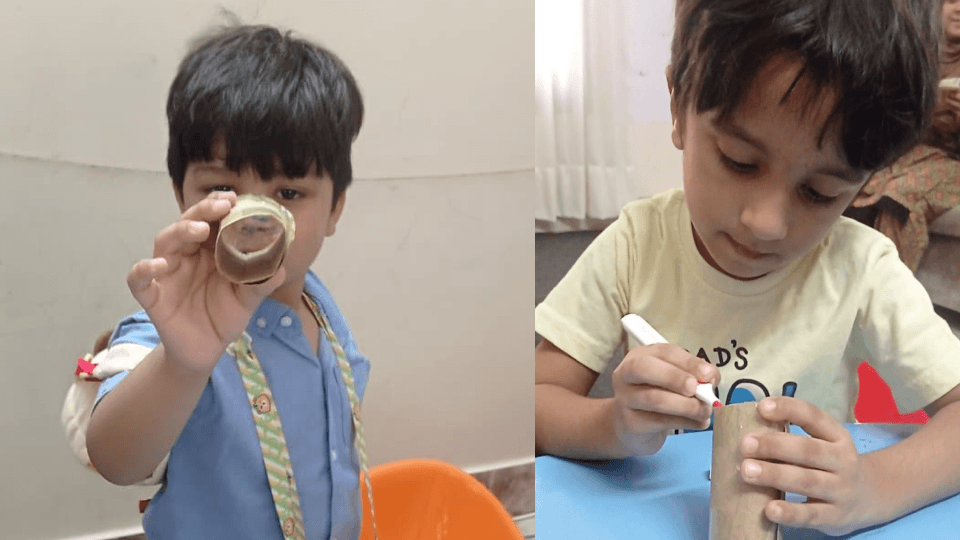
DIY Crafts for Kids: Simple Ideas That Turn Making Into Learning
A child sits at the table with an empty cardboard box, a few pieces of paper, some glue and a handful of crayons. Five minutes later, the box has become a house, a rocket, or perhaps something nobody in the room can quite identify.
That is often the best part.
Parents sometimes look at a craft activity and see the finished object. Children experience something different: choosing materials, testing an idea, making mistakes, changing their plan and proudly announcing, “Look what I made!”
This is why DIY crafts for kids can be much more than something to keep children busy. When thoughtfully planned, they can become opportunities for creativity, conversation, problem-solving, fine-motor practice and independent thinking.
For families in Pakistan, DIY activities can also be wonderfully practical. You do not need a cupboard full of expensive art supplies. Recycled cardboard, paper rolls, old newspapers, fabric scraps, leaves, bottle caps and safe household materials can become the starting point for meaningful creative play.
What Are DIY Crafts for Kids?
DIY crafts for kids are hands-on creative activities where children make, build, decorate, design or transform something using accessible materials.
The important word is not necessarily craft. It is make.
A child might create a paper collage, build a cardboard vehicle, turn a paper plate into an animal, make a nature picture from leaves or construct a simple structure from recycled boxes.
For younger children, the activity does not need to produce a perfect final product. In fact, open-ended art experiences can give children more room to make choices and explore their own ideas. NAEYC describes process-focused art as an experience where children explore materials and techniques without having to reproduce a predetermined model.
That distinction matters.
A craft can teach children to follow instructions, but it can also invite them to ask, “What else could I make?”
Why Are DIY Crafts Good for Children?
DIY crafts can support several areas of children’s development at the same time.
When children cut, tear, fold, glue, draw, thread, mould or assemble materials, they are using their hands with increasing control. When they decide what to make, they are planning and making choices. When something does not work, they have an opportunity to rethink their approach.
Open-ended art can also encourage children to communicate about what they are doing, describe materials, express ideas and share their creations. NAEYC identifies connections between process-focused art and physical, cognitive, language, literacy, social and emotional development.
The activity may look simple from the outside. The thinking happening underneath can be surprisingly rich.
DIY crafts can encourage:
- Creativity and self-expression
- Fine-motor coordination
- Planning and decision-making
- Problem-solving
- Vocabulary and conversation
- Independence
- Patience and persistence
- Imaginative play
- Collaboration with siblings or friends
These are not separate lessons that have to happen one after another. A single craft activity can bring several of them together.
DIY Crafts for Kids Should Not Always Look Perfect
This is one of the most useful things parents can remember.
Imagine a child making a paper butterfly. An adult may be tempted to correct the uneven wings, move the eyes into the “right” position or show the child how the butterfly is supposed to look.
But what if the child deliberately made one wing larger?
What if they decided their butterfly needed six eyes?
What if the butterfly became a flying monster halfway through the activity?
There is learning in those choices too.
NAEYC distinguishes process-focused art from product-focused activities partly because open-ended experiences allow children to make choices, explore materials and create something that is genuinely their own.
So instead of asking:
“Does it look right?”
try asking:
“Tell me about what you made.”
That small change can lead to a much better conversation.
10 DIY Crafts for Kids Using Simple Materials
The best DIY activities for children are not necessarily complicated. Here are some ideas that can be adapted for different ages.
1. Cardboard Box Creations
Keep a few clean cardboard boxes instead of throwing them away.
Children can turn them into:
- Houses
- Cars
- Shops
- Robots
- Castles
- Animal homes
- Space stations
Give children cardboard, paper, crayons, tape and child-safe glue, then let them decide what the box becomes.
Learning opportunity: planning, spatial thinking, storytelling and problem-solving.
2. Nature Collage
Collect safe natural materials such as fallen leaves, small twigs, petals and grass.
Children can arrange them on paper to create pictures, patterns or imaginary creatures.
This can easily become a STEAM-inspired activity. Children can sort leaves by size, compare textures, count objects or discuss where different materials came from.
NAEYC has also highlighted eco-art as a way to connect creative work with science, engineering and mathematics.
3. Paper Roll Animals
Save empty paper rolls and turn them into animals.
A child might make a lion, owl, rabbit, elephant or completely imaginary creature.
Ask questions such as:
- Where does your animal live?
- What does it eat?
- Can it fly?
- What is its name?
- What happens when it meets another animal?
Now a simple craft has become a storytelling activity.
4. Bottle-Cap Patterns
Clean bottle caps can become useful loose parts for supervised craft activities.
Children can arrange them into:
- Colour patterns
- Shapes
- Flowers
- Faces
- Numbers
- Simple pictures
For younger children, the adult can introduce concepts such as colour, size, position and counting.
Important: small objects should only be used when developmentally appropriate and with close adult supervision.
5. Paper Plate Masks
A paper plate can become the starting point for an imaginative character.
Children can add paper, crayons and other safe materials to create a mask.
Then let the craft continue into dramatic play.
“Who are you?”
“Where are you going?”
“What is your character trying to do?”
The craft becomes the beginning of a story rather than the end of an activity.
6. Recycled Newspaper Collage
Old newspapers and magazines can be cut or torn into pieces and arranged into a collage.
For younger children, tearing paper can be easier than using scissors and still gives them an opportunity to work with their hands.
Children can create anything from a colourful abstract design to a city, garden or family picture.
7. DIY Greeting Cards
Children can create cards for family members, friends or teachers.
Instead of giving them a template, provide paper and materials and ask:
“Who would you like to make something for?”
This adds an emotional and social purpose to the activity.
8. Homemade Dough Creations
With an age-appropriate homemade dough, children can roll, pinch, flatten, twist and shape the material.
They can make food, animals, letters, shapes or imaginary objects.
The adult can introduce vocabulary such as:
- Soft
- Hard
- Smooth
- Rough
- Long
- Short
- Heavy
- Light
Process-focused art experiences can give children opportunities to explore materials while developing physical and cognitive skills.
9. Build a Mini City
Give children cardboard pieces, paper, boxes and drawing materials.
Challenge them to create a small city.
Where will the school go?
Where are the houses?
Can they make a road?
Where will people park?
This is particularly useful for children who enjoy building more than traditional drawing or painting.
It also opens the door to early engineering and spatial-thinking conversations.
10. “Invent Something” Challenge
Instead of telling children what to make, give them a few materials and a challenge:
“Can you invent something that helps a person?”
It could become a robot, vehicle, tool, house or something completely unexpected.
There is no single correct answer.
That is the point.
How Can Parents Make DIY Activities More Educational?
You do not have to turn every craft into a formal lesson.
Instead, pay attention to the questions you ask.
If a child is building a cardboard bridge, ask:
“What do you think will happen if we put another box on it?”
If they are making a collage:
“Why did you choose these materials?”
If their structure falls down:
“What could we change?”
These questions encourage children to explain, predict, test and reconsider their ideas.
NAEYC specifically recommends open-ended questions during process art to encourage children to think about their choices, materials and experiences.
Harvard’s Center on the Developing Child also explains that children develop executive-function skills such as planning, focusing attention, managing information and making decisions through supportive developmental experiences.
The goal is not to make the craft academically complicated.
The goal is to give children something worth thinking about.
What Materials Can You Use for DIY Crafts at Home?
You may already have most of what you need.
Simple craft materials
- Plain paper
- Coloured paper
- Cardboard
- Paper rolls
- Paper plates
- Crayons
- Washable paints
- Child-safe glue
- Yarn
- Fabric scraps
- Clean packaging
- Newspaper
- Egg cartons
- Leaves
- Fallen petals
- Clean bottle caps
- Craft sticks
Before giving children recycled or household materials, check that they are clean, safe and suitable for the child’s age.
Avoid sharp edges, toxic materials and small loose parts when working with children who may put objects in their mouths.
How Do You Choose DIY Activities for Different Ages?
The same activity can work for different ages if the expectations change.
Preschool children
Keep the activity simple and flexible.
Focus on:
- Tearing and sticking
- Drawing
- Painting
- Dough
- Large collage materials
- Simple building
- Colour and shape exploration
The child should have plenty of freedom to explore.
Early school-age children
You can introduce more complex challenges.
Try:
- Cardboard engineering
- Model building
- Simple weaving
- Recycled-material inventions
- Story-based crafts
- Pattern-making
- Collaborative projects
Older children can also help plan the materials and explain how their creation works.
The important thing is to match the challenge to the child’s abilities rather than the child’s age alone.
DIY Crafts vs. Step-by-Step Crafts: Which Is Better?
Neither approach is automatically better.
A step-by-step craft can help children practise following instructions and completing a sequence. It can also be useful when learning a particular technique.
But if every activity requires children to copy an adult’s example, there may be less room for personal decision-making.
Process-focused art takes a different approach: children receive materials and an opportunity to explore rather than being expected to reproduce one finished example.
A balanced environment can include both.
The key question is:
Are children sometimes given the freedom to create something that adults did not already imagine for them?
How Can DIY Crafts Support STEAM Learning?
DIY crafts can naturally connect creativity with STEAM when children are encouraged to investigate how things work.
For example, building a cardboard bridge can involve:
Science: What happens when weight is added?
Technology: What tools or materials could help?
Engineering: How can the structure become stronger?
Art: How can the bridge be designed?
Math: How long, tall or wide should it be?
The craft does not need to become a formal science experiment.
A simple question such as “How can we make it stronger?” may be enough to start the thinking process.
Why DIY Activities Matter in a Preschool Environment
A preschool classroom should not only be a place where children receive information. It should also be a place where they can investigate, make choices, talk, move, build and create.
Playful learning gives children opportunities to explore ideas actively. UNICEF’s early childhood resources emphasize play as a context for exploration, problem-solving and understanding the world around them.
The American Academy of Pediatrics likewise describes play as important for children’s cognitive, physical and social development and encourages playful approaches in early childhood settings.
At Kids Bootcamp & Preschool in Multan, this way of thinking fits naturally with a child-centered approach to creativity, exploration and hands-on learning.
A craft table can become an art studio.
A cardboard box can become an engineering challenge.
A pile of leaves can become a science investigation.
And a child’s strange-looking creation can become the beginning of a story.
How Can Parents Encourage Creativity Without Taking Over?
This is perhaps the hardest part.
Adults often want to help.
But sometimes helping means stepping back.
Instead of:
“Put the eyes here.”
Try:
“Where do you think the eyes should go?”
Instead of:
“That won’t work.”
Try:
“Let’s see what happens.”
Instead of:
“Make it like this.”
Try:
“What are you thinking of making?”
You can demonstrate how to use scissors, glue or another tool safely without designing the entire project for the child.
NAEYC recommends allowing children time and space to explore materials and encourages adults to resist redirecting children’s ideas simply because they differ from the original plan.
Sometimes the most valuable thing a parent can say is:
“Tell me about it.”
DIY Crafts for Kids in Pakistan: Keep It Simple
For families in Pakistan, creative activities do not have to depend on imported craft kits or expensive materials.
A rainy afternoon, a hot Multan day when outdoor play is less comfortable, or a quiet weekend can become an opportunity to create something from materials already available at home.
Save packaging.
Reuse cardboard.
Collect safe natural materials.
Keep a small box of paper scraps.
Let children experiment.
The important resource is not the material itself. It is the opportunity for the child to make choices and explore an idea.
This is also one reason recycled-material crafts can work particularly well in a preschool setting: the materials are familiar, inexpensive and flexible.
A Simple DIY Craft Routine for Parents
If your child loses interest quickly, try a simple routine.
1. Prepare
Place a few materials on the table rather than giving your child an entire cupboard.
2. Invite
Give your child a simple starting idea.
For example:
“Can you make a home for an animal?”
3. Step back
Allow the child to decide what the creation should look like.
4. Ask
Use questions instead of instructions.
5. Extend
If the child makes a house, perhaps the next question is:
“Who lives there?”
6. Celebrate the process
Praise effort, ideas and persistence rather than only the finished appearance.
Instead of saying:
“That is beautiful.”
try:
“I noticed you tried three different ways to make the roof stay up.”
That tells the child that thinking and persistence matter.
The Best DIY Craft May Be the One You Cannot Predict
A good craft activity does not always produce something that belongs on a Pinterest board.
Sometimes it produces a crooked house.
Sometimes a robot with three arms.
Sometimes a painting that looks like nothing to an adult but represents an entire story to a child.
That is okay.
Children do not need every creative experience to end with a perfect product. They need opportunities to experiment, express ideas, solve small problems and discover what they can do.
That is the real value behind DIY crafts for kids.
At Kids Bootcamp & Preschool, we believe meaningful learning can begin with something as simple as paper, cardboard, colour and a child’s own idea. For parents looking for engaging DIY activities for kids, the best place to start may already be sitting in the recycling box.
Conclusion
DIY crafts for kids can be simple, affordable and genuinely educational. The strongest activities are not necessarily the ones that produce the most polished results; they are the ones that give children room to choose, explore, build, change their minds and try again.
For parents in Multan and across Pakistan, that can mean creating meaningful learning opportunities without buying expensive materials or turning every afternoon into a formal lesson.
Give children some materials.
Give them time.
Ask a few good questions.
Then see what they come up with.
FAQs
What are the easiest DIY crafts for kids?
Some easy options include cardboard-box creations, paper collages, paper-roll animals, nature collages, paper-plate masks and simple recycled-material projects. Choose activities based on the child’s age and provide materials that allow some freedom rather than requiring an identical finished product.
What are the benefits of DIY activities for kids?
DIY activities can give children opportunities to practise creativity, fine-motor coordination, planning, communication, problem-solving and independent decision-making. The benefits depend on how the activity is designed and how much opportunity children have to explore and make choices.
Are DIY crafts suitable for preschool children?
Yes. Preschool children can enjoy simple crafts involving drawing, painting, tearing, gluing, clay or dough, collage and large recycled materials. Activities should be age-appropriate, supervised and flexible enough for children to explore rather than simply copy an adult’s finished example.
What can I use for DIY crafts at home?
You can use paper, cardboard, newspaper, paper rolls, paper plates, fabric scraps, yarn, washable colours, child-safe glue and safe natural materials. Clean recycled packaging can also become useful for building and creative projects.
Should parents help children with crafts?
Parents should help children use materials safely, but they do not need to control the final result. Asking questions such as “What are you making?” or “How could we make it stronger?” can encourage children to explain their ideas and solve problems independently.
Are step-by-step crafts good for children?
They can be useful for practising instructions and particular techniques, but they should not be the only type of creative experience. Open-ended process art gives children more freedom to make choices, experiment and create original work.
How can crafts become STEAM activities?
Add questions involving science, engineering or mathematics to a creative project. For example, when building a cardboard bridge, children can test its strength, compare sizes, count materials and redesign the structure when it falls.
What are good DIY activities for kids in Pakistan?
Simple recycled-material projects work particularly well because they can use materials commonly available at home, such as cardboard, newspapers, paper rolls and packaging. Nature-based crafts can also use safe fallen leaves and other locally available materials.
